
SIBO treatment lasts when it reduces the bacterial overgrowth and also corrects the reason the bacteria overgrew, most often slow gut motility, low stomach acid, poor bile flow or constipation. Dr. Houston Anderson, DC, MS is a functional medicine doctor and licensed chiropractic physician in Arizona (licence #8460). Our offices in Mesa and Scottsdale treat SIBO with herbal therapy, diet and motility support. A new patient visit lasts 90 minutes.
What Is SIBO?
SIBO (small intestinal bacterial overgrowth) is an excess of bacteria in the small intestine, often including bacteria that normally live in the colon. The small intestine absorbs nutrients and normally holds few bacteria. SIBO bacteria ferment food before the body absorbs it, which produces gas. SIBO is an overgrowth, not an infection caught from another person.
What Are the Types of SIBO?
SIBO has three types, named after the gas the organisms produce. The three types of SIBO are listed in the table below.
| Type | Gas produced | Pattern patients report most |
|---|---|---|
| Hydrogen SIBO | Hydrogen | Bloating with loose stools or diarrhea |
| Methane overgrowth (IMO) | Methane | Bloating with constipation |
| Hydrogen sulfide SIBO | Hydrogen sulfide | Diarrhea, gas with a sulfur odor |
Methane is produced by archaea, not bacteria, and gastroenterology guidelines now call the methane type intestinal methanogen overgrowth (IMO).
What Are the Symptoms of SIBO?
The main symptom of SIBO is bloating that builds after meals. The symptoms of SIBO are listed below.
- Bloating and abdominal distension: gas from fermentation in the small intestine.
- Excess gas and belching: often within one to two hours of eating.
- Abdominal pain or cramping: pressure from gas in a narrow section of gut.
- Diarrhea or loose stools: more common with hydrogen SIBO.
- Constipation: more common with methane overgrowth.
- Reflux and nausea: pressure from gas pushes upward.
- Fatigue and nutrient deficiencies: bacteria use vitamin B12 and interfere with fat absorption in long-standing SIBO.
SIBO symptoms overlap with IBS. A 2020 meta-analysis of 25 studies in the American Journal of Gastroenterology found SIBO on breath testing in 35.5% of 3,192 patients with IBS. Our page on IBS treatment explains how the two conditions are separated.
Why Does SIBO Come Back?
SIBO comes back when the overgrowth is cleared and the condition that allowed the overgrowth stays in place. A 2008 study in the American Journal of Gastroenterology followed 80 patients after antibiotic treatment for SIBO. Breath tests turned positive again in 12.6% at three months, 27.5% at six months and 43.7% at nine months. The reasons SIBO returns are listed below.
- Slow motility: the small intestine clears bacteria with cleansing waves between meals. Weak waves leave bacteria in place.
- Constipation: stool that stays in the colon allows colonic bacteria to move upward.
- Low stomach acid: acid limits the bacteria that reach the small intestine. Long-term acid-suppressing medication lowers this defence.
- Poor bile flow: bile acids limit bacterial growth in the small intestine.
- Structural causes: adhesions from surgery, a weak ileocecal valve, or diverticula hold bacteria.
- Diet returned too early or too broadly: fermentable carbohydrates feed the remaining bacteria.
SIBO treatment at our practice addresses the overgrowth and the reason for recurrence in the same plan.
How Do We Test for SIBO?
SIBO is tested with a breath test that measures hydrogen and methane after a sugar drink. The patient drinks glucose or lactulose and breathes into collection tubes at intervals. The American College of Gastroenterology guideline of 2020 defines a positive test as a rise in hydrogen of at least 20 parts per million within 90 minutes. Methane of 10 parts per million or more indicates methane overgrowth. We guide patients on breath testing when the history points to SIBO, and we review breath tests already done by a gastroenterologist. The first visit also covers the history, a physical and applied kinesiology examination, and the pattern of symptoms after meals.
How Do We Treat SIBO?
We treat SIBO in three parts: reduce the overgrowth with herbal therapy, restore motility and bile flow, and adjust diet while the gut recovers. Dr. Anderson does not prescribe antibiotics.
How Does Herbal Therapy Treat SIBO?
Herbal therapy treats SIBO with plant-based antimicrobials taken for several weeks. A 2014 Johns Hopkins study in Global Advances in Health and Medicine reviewed 104 patients with SIBO. A follow-up breath test was negative in 46% of 37 patients after herbal therapy and in 34% of 67 patients after rifaximin. The difference was not statistically significant, and the study was a review of patient records, not a randomised trial. Our herbal protocols for SIBO are chosen for the SIBO type and adjusted at each follow-up visit.
How Is Motility Restored After SIBO?
Motility is restored after SIBO by treating constipation, spacing meals, and supporting the gut’s cleansing waves. Regular bowel movements reduce the return of bacteria from the colon. Meal spacing gives the cleansing waves time to work. Motility support continues after the herbal phase ends.
What Diet Is Used During SIBO Treatment?
SIBO treatment uses a short-term reduction in fermentable carbohydrates, followed by a planned return to a wider diet. A restricted diet lowers symptoms and does not clear SIBO. Long-term restriction is not the goal of SIBO treatment.
What Happens When Rifaximin or a Low FODMAP Diet Has Not Worked?
SIBO that persists after rifaximin or a low FODMAP diet usually has an untreated cause behind it. We review the earlier treatment, the SIBO type and the recurrence factors listed above. Patients with relapsing SIBO are common in our practice. Care continues alongside the patient’s gastroenterologist.
How Long Does SIBO Treatment Take?
SIBO treatment at our practice begins with a 90-minute first visit, followed by two follow-up visits two weeks apart. Follow-up visits last 30 to 60 minutes. The herbal phase runs for several weeks, and motility support runs longer. New patient appointments are usually available within two to three weeks. Visits cost $75 to $497, and our practice is out of network for all insurers. Details are on our fees and insurance page.
Related Questions About SIBO
What Causes Bloating with SIBO?
Bloating with SIBO is caused by hydrogen or methane gas that bacteria produce while fermenting food in the small intestine. The small intestine is narrow, so a small volume of gas produces marked distension. Bloating from SIBO typically increases through the day.
Is SIBO the Same as SIFO?
No, SIBO is a bacterial overgrowth and SIFO is a fungal overgrowth of the small intestine. The symptoms overlap, and a breath test does not detect SIFO. Our article on SIFO symptoms and treatment covers the difference.
Does SIBO Cause IBS?
SIBO causes IBS-type symptoms in a share of patients, and SIBO is one of several causes we check for in IBS. Treating SIBO resolves symptoms for some patients with IBS. Other patients have bile acid malabsorption or food triggers instead. Our page on bile acid malabsorption treatment covers urgent diarrhea that does not respond to SIBO treatment.
Is SIBO Linked to Leaky Gut?
Yes, SIBO is associated with increased intestinal permeability, which is commonly called leaky gut. Bacterial overgrowth irritates the lining of the small intestine. Our page on leaky gut treatment explains the link.
What Is the Standard Medical Treatment for SIBO?
Standard medical treatment for SIBO is a course of antibiotics, most often rifaximin, with neomycin or metronidazole added for methane overgrowth. Gastroenterologists also use an elemental diet in resistant cases. Functional medicine care works alongside this treatment, and patients do not need to choose one or the other.
When Does SIBO Need a Medical Doctor First?
SIBO symptoms need a medical doctor first when any warning sign is present. The warning signs are listed below.
- Blood in the stool or black stools
- Unintended weight loss
- Persistent vomiting
- Fever with bowel symptoms
- Anemia or known vitamin B12 deficiency
- New symptoms after age 50
Where Is SIBO Treatment Available in Mesa and Scottsdale?
SIBO treatment with Dr. Houston Anderson is available at two offices, in Mesa and in Scottsdale, Monday to Thursday from 7 AM to 5 PM. The Mesa office is at 4862 E Baseline Rd, Ste 108, Mesa, AZ 85206. The Scottsdale office is at 16700 N Thompson Peak Pkwy, Ste 260, Scottsdale, AZ 85260, inside AZ Multicare. A new patient visit is booked online for either office.
Dr. Anderson’s View
SIBO is too much bacteria in the wrong place, so we do not use probiotics during SIBO treatment. We treat the large intestine and the small intestine together, because the overgrowth often starts in the colon. A negative breath test does not always rule SIBO out, and we weigh the test against the symptom pattern.
Visit our clinic in Scottsdale, AZ
Visit our clinic in Mesa, AZ
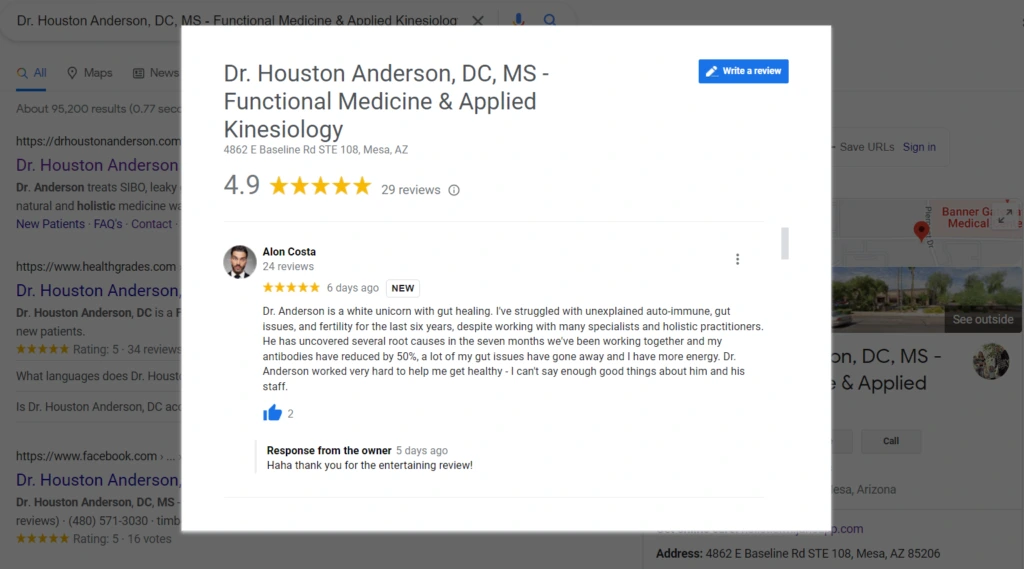
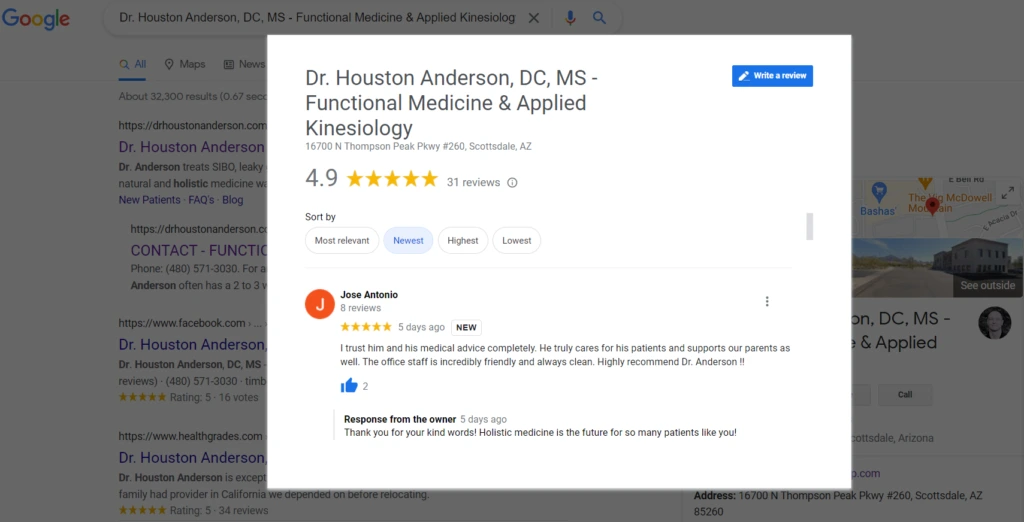
We have so many happy patients; they also rated five stars and shared reviews about Dr. Houston Anderson on Google Maps
Our Clinics (Scottsdale, AZ & Mesa, AZ) Working Hours
Monday
7AM–5PM
Tuesday
7AM–5PM
Wednesday
7AM–5PM
Thursday
7AM–5PM
Friday
Closed
Saturday
Closed
Sunday
Closed
Email: office@drhoustonanderson.com · Schedule Online: Click Here
Our clinics are in Scottsdale, AZ - Mesa, AZ, and our patients come from surrounding Arizona areas!
Phoenix, AZ, USA
Tempe, AZ, USA
Carefree, AZ, USA
Paradise Valley, AZ, USA
Cave Creek, AZ 85331, USA
Anthem, Phoenix, AZ, USA
Queen Creek, AZ, USA
Gilbert, AZ, USA
Apache Junction, AZ, USA
Gold Canyon, AZ, USA
Chandler, AZ, USA